Instruments

Our lab designs and builds advanced instrumentation, drawing on ion mobility spectrometry, mass spectrometry, laser spectroscopy, and velocity-map imaging. We operate two instruments called PASTA and PISA.

Our goal is to develop methodologies for probing spectroscopy and dynamics that are not possible anywhere else in the world. This represents fundamental innovation and requires researchers to be proficient in mechanical design, electrical circuits, computer interfacing and programming, data acquisition and processing, as well as the relevant theoretical models and calculations.

PASTA - Photoinduced Action Spectroscopy Targeting Anions

PASTA instrument at UEA
Illustration of the PASTA instrument developed at UEA. This image was taken from our Rev. Sci. Instrum. instrument paper, which has a complete description of the ToF and VMI regions.

The PASTA (Photoinduced Action Spectroscopy Targeting Anions) instrument at UEA, shown to the left, was developed by the Bull group with support from an EPSRC New Investigator Award. At present, PASTA is interfaced with an EKSPLA NT-342B OPO laser system and a Continuum Surelite Nd:YAG with 532/355 nm generation crystals. We have purchased a Light Conversion PHAROS femtosecond laser with OPA and HIRO module, which will be set-up in mid-2026 to allow for time-resolved photoelectron experiments..

The PASTA instrument utilises tandem ion mobility spectrometry, quadrupole ion trapping, time-of-flight mass spectrometry, and orthogonal photoelectron velocity-map imaging. It has been developed around standard 6 in. and 2-3/4 in. ConFlat flanges and the use of 3D printable mounts and holders, allows the instrument to be adapted easily to incorporate a variety of ion sources or additional sectors as applications demand.

Features are:

● Coupling with electrospray ionisation, tandem ion mobility spectrometry, and ion trapping, allowing for photoisomerisation action spectroscopy, isomer-specific photodetachment and photoelectron spectroscopies (in both frequency and time domains), and the photogeneration, separation, and study of transient intermediates that survive for a few milliseconds or longer.
● Capabilities to perform both photodetachment (resolution limited by laser bandwidth) and photoelectron spectroscopies on anions and to record photoelectron spectra simultaneously when acquiring a photodetachment spectrum (i.e., frequency-resolved photoelectron spectroscopy).
● The versatility to generate ions from easily interchangeable hard- and soft-plasma pulsed valve sources for astrochemical applications. Using these pulsed-valve sources, the instrument should be capable of studying small anions (a few atoms) to moderately sized anions (≈60 atoms) through time-of-flight mass spectrometry.
● Velocity-map imaging detection to acquire electron kinetic energies without discrimination effects and to record angular information about photoelectrons.
● The capacity to disentangle prompt and delayed (e.g., thermionic emission) signals in both photoelectron and photodetachment spectra by time-gating the photoelectron detector (≈5 ns time resolution) relative to the laser.


PISA - PhotoIsomerisation Action Spectroscopy

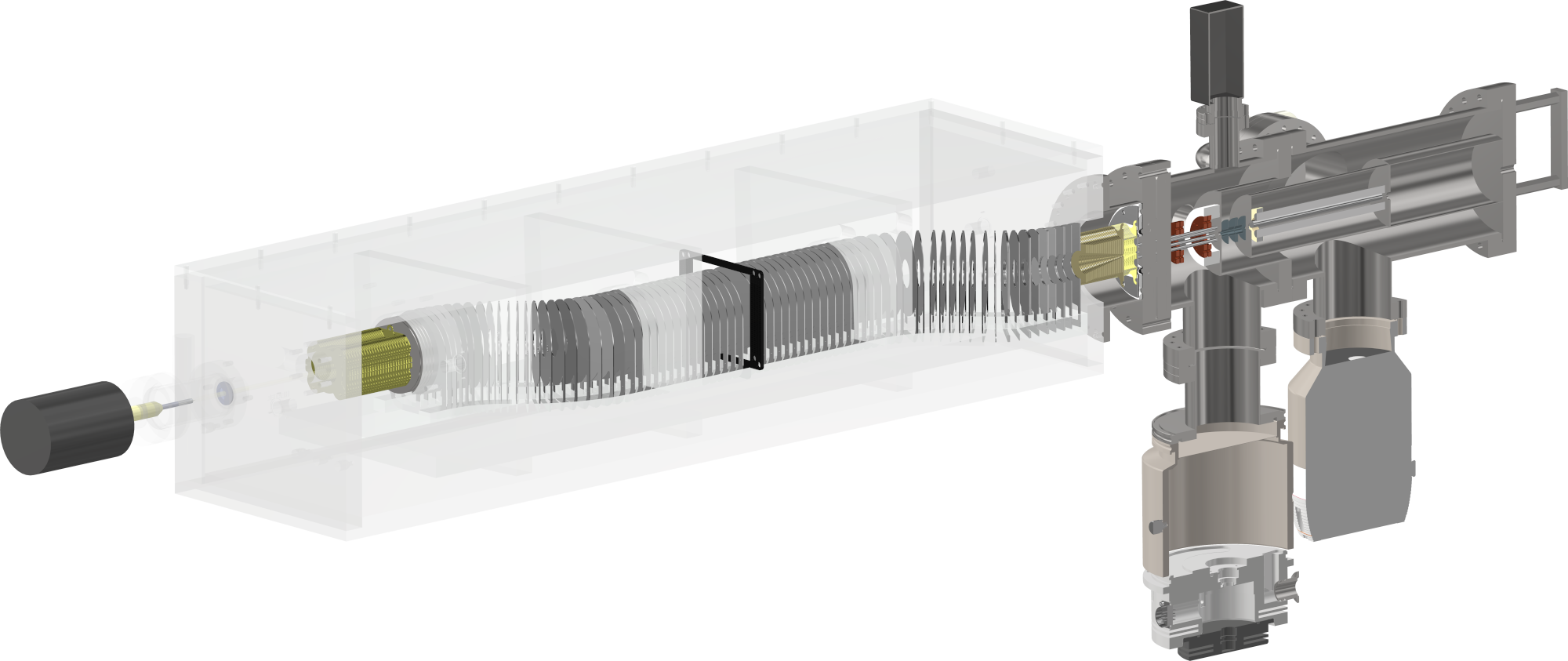
Compared with photodissociation, photodetachment, and photoelectron spectroscopies, the technique of photoisomerisation action spectroscopy (PISA) is an emerging technique. PISA spectroscopy, which was pioneering by the Bieske group at The University of Melbourne in Australia, couples tandem ion mobility mass spectrometry with laser spectroscopy to achieve both isomer-specific spectroscopy and the ability to monitor photoisomerisation directly. The clear identification and separation of isomers, and the ability to monitor photoisomerisation, has conventionally been challenging in gas-phase experiments. Our PISA spectroscopy instrument, much of which was kindly donated by Prof. Evan Bieske, is shown below. The instrument was rebuilt at UEA with new computer control, data acquisition, and vacuum pumping.
PISA spectroscopy instrument at UEA
Illustration of the PISA spectroscopy instrument at UEA. The perspex box is divided into two regions, IMS1 and IMS2, allowing for tandem ion mobility spectrometry.

PISA spectroscopy relies on isomeric ions becoming separated in space (which is related to arrival time or 'traversal time') when the ions are propelled through a drift region containing a buffer gas at a pressure of ~5-10 mbar under the influence of a weak electric field (~44 V/cm). The buffer gas is either N2 or N2 seeded with a trace amount of a dopant such as propan-2-ol or SF6.